Thursday, September 7, 2017

A simple tutorial- About Hand Applique


Hello! Happy Fall! You all know Fall is my favorite season at all time! Cool temperature, warmer lighting, sip tea (any time of the day) and best to that is I am knitting like a mad lady lately! ( Maybe that would be another post). Finally I get around to write this simple hand appliqué tutorial for you. I simply like to share what I use for the process and all the tips that I received from other master hand appliqué sewers. 
So, here we go...

Here are some basic tools that I've used and felt they are a good investment for Hand Appliqué. 

Freezer Paper: You can find Freezer paper in most of grocery store. It comes in a long box. One side  
 of the Freeze paper is coating glossy and the other side is paper finish. You'll draw on the paper finished side and adhere the glossy (plastic coating) side to the cloth with a hot dry iron. 

Gutermann 100% Polyester Thread: I love how fine the thread is and very sturdy! But you can use 
most type of fine thread for the hand appliqué purpose. I would avoid 100% cotton thread as I found it doesn't give clean stitch look on the appliqué pieces. 

Crystal clear Ball pins: This is the best type of pins that I found and love it. It comes with two sizes. 
These are fine, sharp and so easy to pin through layers of fabrics. 

Applique Pins 3/4" steel: These pins are pretty thick, but short. The appliqué pin doesn't catch the hand sewing thread easily because it is short. I use maybe 3-4 pins through out the entire applique pieces. 

Hera Marker Slim: This is a great investment for any type of sewing. The slim Hera Marker
comes with a sharpie point side that allows you to "tuck" the seams in and the opposite side's top comes in a small angle that can make marks on cloth easily. 

Pen : More like mechanical pen.  It allows to draw on the cloth easy and gets clear and accurate lines. 

Appliqué Sharp Needles: Get a pack of these needles! They are probably by far the best hand              
sewing  needles that I've been using for years to come. I love the length and the thickness of the needles! But if you have some sewing needles around you can just use what you love! 

Water Soluble Ink Pen: When you draw on cloth you want to make sure that you'll get to your project within a week or two or some of the drawing lines will fade away due the the moisture in  
the air. 

Scissors:  A small pair of scissors that's sharp and allows to cut clean edges. 

Trash Bowl:  I have a few of these trash bowls on the table. When work on hand appliqué there will  some small cuts to make and thread to clip. I keep them in the bowl then clean after finish. 


Step 1: It is important to scale the pattern to the desire sizes. If you are a beginner, I recommend to scale appliqué pattern to a large percentage, so you can get some good practice before small scales, so you don't feel discourage!


I like to talk about this LED light Pad! I love it here! When my old-time light box didn't work as I hoped, I began to search for a Light Box, so I can have it around and even though about to build one. But I came cross this LED light pad last year when I was working on an illustration project. It does most of the tracing trick for me, even on fabric! This is really a personal preference for investing a new tool. I've shared with S for her drawing, so it is a good investment for us!

How this work? It doesn't have a plug! You'll insert USB core into a computer (where USB is at) or a power bank. Simply touch the turn on button on the left and the light will come up. Make sure stay in a darker environment for better image showing.  It is pretty thin and light weight, too!


Step 2: Place the appliqué pattern to the light pad ( I used a small piece of washi tape to held the pattern in place). Lay a piece a Freezer paper ( Big enough for the pattern) on top of the appliqué pattern. Use a pen to trace images. You'll want make sure you do a good job in tracing the pattern because these are becoming appliqué templates for each piece. 

Finish Tracing Pattern on Freezer Paper

Step 3: Keep the appliqué pattern on top of light pad. Place the appliqué background cloth on top of the pattern. Use water soluble ink pen to trace images onto the cloth.  

 Step 4: Now you shall have traced the pattern onto cloth and freezer paper.

Step 5: This is an important step before starting hand appliqué pieces. I always study the pattern before I start; making indications of first, second, third. What does that mean? You ask? Appliqué is a like cut and paste process to a project. Only here, we use cloth instead of paper, we use thread instead of glue. So when you are layering your pieces down you want to know which one goes first  then second then third.

Clover mini Iron: This is another really cool tool that I like to share with you. I have had this mini iron about 7 years now! But I rarely use it the first couple of years because it is somewhat dangerous around small children.

How this mini iron works? The mini iron comes with an attached plug and a little turn just below the metal part to turn the iron on. It takes 3-5 minutes to heat up the top. However, thhe whole top that made from metal is "HOT". I have burn myself a few time because had it sat so close when I work. The little rest stand gets hot as the metal top is rest on that. So, be so careful after you unplug it. Let is sat a good 10 minutes before putting it away.

I have to say this is a pretty amazing tool when it comes working with appliqué pieces, but I always ask to be leave alone when I am using it.


Step 6: How I like to start the appliqué pieces. I always like to start with image that takes maybe two or three pieces to make into one appliqué image.  The small tulip comes with three small pieces, so it is ideal for a start.  Cut the individual freezer paper pieces out.

Step 7: Adhere the freezer paper piece to the RIGHT side of the cloth that you have planned. 

 Step 8: Repeat for other two pieces.

 Step 9: Single thread the appliqué sharp needle. Make a small knot at the end.

Step 10: This step might be slightly differ than others. I didn't like working with a freezer paper on top of the cloth, so I gently trace around the template with mechanical pen. So that leave the template shape on the cloth.

Step 11:  Place the appliqué piece on to the background cloth. On the Step 3, you've spent some time to trace the pattern onto the background cloth. This would allow you to place the appliqué piece to the correct place. ( A like drawing with black pen, now you are filling in with colors, but this time with cloth).  Use a small crystal pin to stab on the points of appliqué piece and background cloth, so they are match in place.

 Step 12: Insert the appliqué sharp needle behind the small appliqué piece. You can start anywhere, but I like to start from edge point.

 Step 13:  Gently use the needle point or finger to fold the line that you have mark from Step 10 

Step14: Start stitching.  Run the needle down through both layers of fabric. Then catch the thread from the preceding stitch under the tip of the needle. You'll follow along the drawn line and finish up the piece; gently pull the thread tight and repeat for all the pieces.

Step 15: Since there is a third piece that will cover on both side pieces. I left the edge close to center unstitch.

 Step 16: When finish, double knit the end.

 Step 17: Repeat step 10-16

 Step 18: Now when two pieces have down. It should look like this.

 Step 19: Add on the third appliqué piece to close up the unstitched edges.

 Repeat for all tulips appliqué pieces.

Step 20: When it comes with curvy appliqué piece.  You'll find a single traced freezer paper is not thick enough to make the curves show during ironing process. You can adhere two pieces freezer paper together before cut out the image or even layer three pieces freezer paper together, so it creates a "thicker" template.

 Step 21: Do the same for the center small circles

 Step 22: Place the freezer paper template on the WRONG side of the cloth with hot/warm iron.

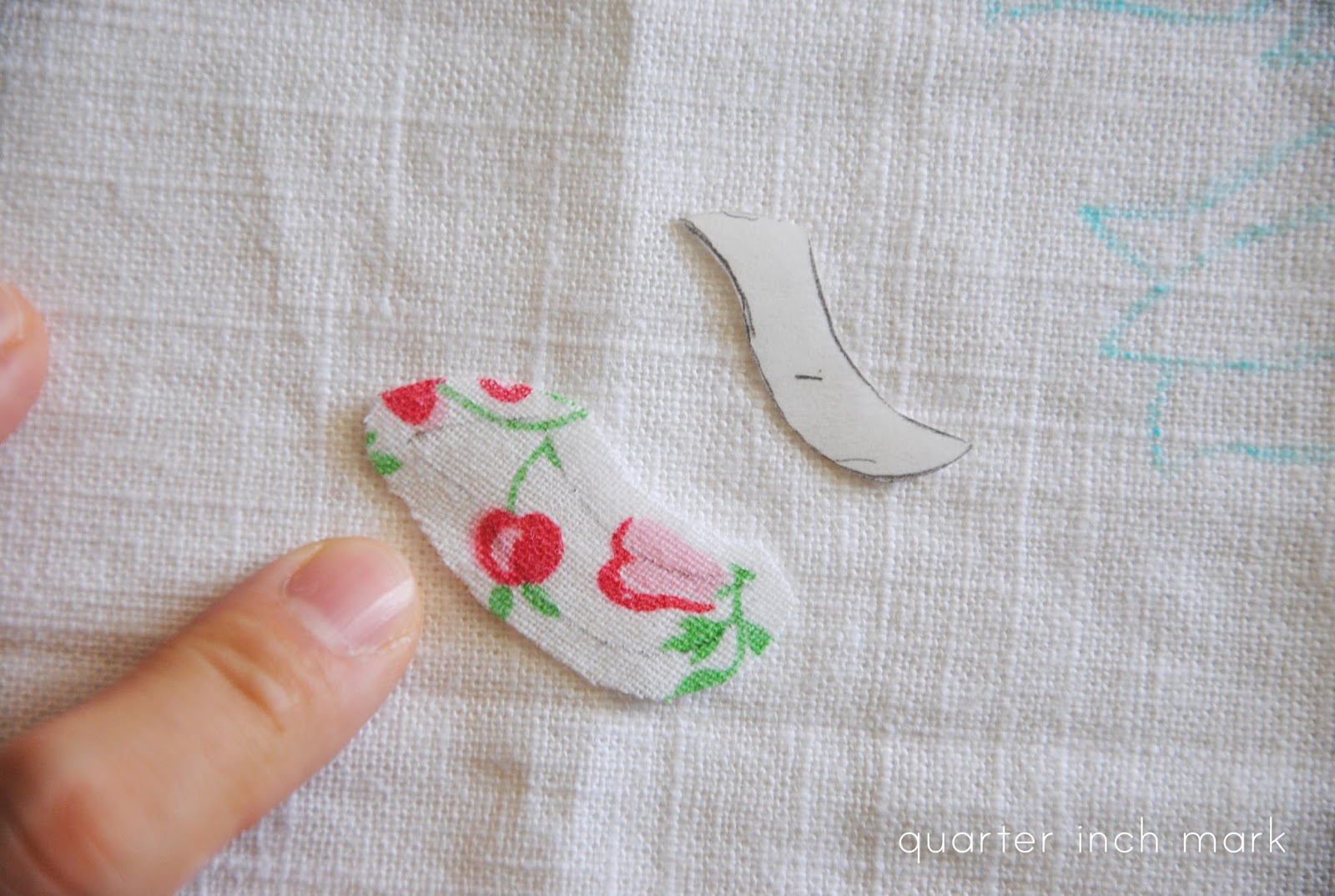
Step 23: Cut 1/4" seam allowance around the cloth that adhered with freezer paper template. Gently make small cuts around the curves, but not too close to the template.

Step 24: Use tip of the mini iron and gently iron on the angles of the templates. It will take a few  ironing times. When you iron the appliqué cloth, use your finger as aid to fold down the edges down as well.

 Step 25: The appliqué piece should have some nice curves after good ironing.

Step 26: Making small circles. It is very similar to how make a small yo-yo, but only with a small piece of freezer paper inside. Make running stitches around the seam allowances (seam allowance need to be less than 1/4"}

 Step 27:  Gently iron the circles then really carefully pull the paper out.

Step 28: For curvy applique piece, I've always over done with using pins. I try to match up the appliqué piece and the background lines together.  I always use extra pins then take out pins as I work on. 

Insert the appliqué sharp needle behind the appliqué cloth ( Step 13) then start small hand stitches around the piece. Use appliqué needle points to tuck in any seam allowance that come out and use the needle point to shape the appliqué piece as you go along the process. 

Step 29:  Place the small circle on top of the finish curvy appliqué piece. Gently stitch along with circles.

Now, I'll continue to work on the piece and writing a second post on flower stems appliqué and show you more of this process along! Then a finish touch of how to frame the work. So stay turn for future post on hand appliqué.  I do believe that hand appliqué is truly something more about hands and stitches making. I used to not hide out all the hand stitch threads, but now I do have more application of seeing some small thread showing and that is part of the reason I use red thread, a more promising process to myself.

Enjoy

xxc


SaveSave

Monday, July 31, 2017

Slow Stitching Studio


As I worked on the new appliqué piece, I took notes on the sewing tools and materials frequently being use.   I though I'd write two separate posts about the hand-applique (or maybe narrow down to one). Would it be good idea to give some pros and cons on the tools I use?  Does any of you like hand appliqués?

The mini floral appliqué is finished at 3.5"x3.5". I had to scale it down, so it can fit into a 4"x6" frame. I did a couple test printings before finalized the size and love the end of piece! The challenge probably was making the small circles to be "rounded" before hand appliqué down. I decided to let the red stitches to be more seen and found this time. Lots Feedsacks fabrics are used and they are my favorites to work on hand appliqué. I'd also recommended light weight-cotton, Liberty London fabrics, and lawn fabrics are perfect, too.  Just a lot possibilities for the hand appliqué. You don't really need a large pieces for small shapes. The smallest pieces that I've worked on is 0.5"x 0.5". So you can save all the tiny scraps for it.

The floral appliqué that was finished a few weeks ago got framed after I got new frames from IKEA. This time, I have better luck on getting it into the frame. The linen that was use as background is white and I would really love to used snow white next time if I have access to some snow-white linen. It probably will give the piece more in-depth turnout.

Since last Fall, I've been getting back to hand appliqué more.  It is a slow stitching studio practice, but somehow I really enjoy sitting down and hand-stitching small pieces together. I am tickled have them finished and framed now. The second large hand appliqué piece that I made last year has been made into a {travel outbound bag} and have been use it for storing vintage patterns. It is a larger travel outbound bag and I would love to travel with it soon!

I've also had the second Honey Cowl off the needles and cast the third one on! This time, I used knit stitches and it goes really quick! Did you know, yarn stitching is so nice on the bus rides, waiting at the doctor's office and trip to Brooklyn. I've also got some new yarn from the sale section and have casted on the fourth cowl. I'll keep practicing until I am ready for a shawl and guess what? The pattern have been purchased and just need to sit down and learn the new stitching names and how. Of course, getting new yarns and fancy a shawl for this Fall.

{Shop Talk} 
Thank you again and again for your support and positively responds about the {Boathouse Pouch Sewing Pattern}. I hope you'll love the pattern and enjoy making it! I will be making a large custom order base on Boathouse pouch pattern and can hardly wait to start pulling fabrics out. I've made a set for my sister right after the finished the pattern writing.  The scooter print and the car print are just perfect for her!

Thank you all so much for taking your time and leave kindly commons on the patterns you have purchased. You know that means a lot to me as a designer and great impact on the feature patterns that I write and inputs to improve for as well, {Thank You}!

I've been working on another pattern and is almost ready transfer into a PDF formate, not bag nor pouch pattern this time. I've been acquired materials and fabric to work on different methods of piecing. The sewing pattern will be release in this upcoming Fall.  It is surely my Big Apple City life inspiration since I relocated here!  Stay turn.


more later...

xxc


Wednesday, July 19, 2017

Boathouse Pouch Sewing Pattern


Happy Mid-Summer! I am super excited to have my newest PDF sewing pattern, Boathouse Pouch release during the mid-summer days.  I've been working on the pouch concepts since early spring and created a few prototypes before finalized the pouch shape and best way to approach Boathouse Pouch sewing techniques.

Oh, Boathouse Pouch, you ask? This is such a cute pouch and comes with great divider spaces that you'll want to give it a go!

Growing up, I’ve spent much of my summer time at my grandparents’ old red brick house that was an hour's drive away from the city I used to live. Playing in the rice field, feeding cows, catching frogs, walking barefoot in creeks, and getting in trouble by picking the neighbor’s fruits. There was a lot of outdoor activities to do during the summer time in the rural countryside; plenty dirt and mud time. 

Origami (folding paper) seemed to be the most popular craft at the time for us, kids. Grandma would sent us outdoor with a stack of newspaper that she got from the open market. My siblings and I’d fold a lot of newspaper boats and float them down the creek that resided near the brick house. We bet on who's boat would reach the end of first rock and we all screamed for our own boat to win- boat game!

{Boathouse Pouch Sewing Pattern} is an origami paper boat folding inspired pouch! This pouch has quite a few folding and turning concepts involved within the pouch design. Summer day fun and a bit of tricky and challenging sewing pattern. Nothing very difficult, just like origami, fold and turn. 

 Let me talk a little bit about the Boathouse Pouch. 

Boathouse Pouch is based and inspired by origami (paper folding) boat folding concept. As a pattern designer, I want to keep the originality of the folding boat shape and work around the measurements to suit for the pouch turning and folding technique. The pouch comes with great divider space, which have three compartments to store personal essentials.

On the photo (above), is the size 7", which is perfectly for sewing tools, stationary.  I've set my paper piecing tools, papers, spools of thread in one of boathouse pouch which comes really handy and nothing falls out the pouch.

I also love how this pouch design shows the original boathouse concept. Within the PDF sewing pattern will show you how you can sew use different fabric to sew the boat base in a different outlook. You'll be surprised how easy the tricks are and fun ideas can be play in sewing pouches.

Sew the zipper with no fears like every zippered sewing pouch pattern. Within the pattern there are step-by-step colored photos to guild you through each steps. There are a number of pages on how to attach zippers for the pouch, so you can visually see how it actually works. 

For the size 6" zipper: The small scale Boathouse Pouch has been a perfect size pouch for a quick run to the stores. Maybe petty cash, metro cards, or few coins in the pouch. The middle compartment is perfect for "cards"(Ex: business card, credit card, metro card, etc.)

The center compartment comes slightly smaller then the two side compartments. It is originally designed for storing small items. Perfect for items that you like to keep separate from others.

On the two side compartments, it allows you to store bigger objects. (Ex: UBS cards, lip stick, ear phone device, etc.) As you can image, the bottom of the boat expands and gives nice space. It's also perfect for storing needle packs, glue sticks, and rotary blade packs, use it as a sewing aid pouch!


For the 7" pouch, that you will be able to fit quite a bit of sewing essentials. As the picture shows you, there's a pair of small hand scissors, a small rotary cutter, needle book and few spools of thread can be all fit in this size of Boathouse Pouch. 

With all the tools are zipped in the Boathouse Pouch, you'll find that there's rooms for other tools. Both sides of the pouch gives you a nice roomy space.


{Boathouse Pouch PDF Sewing Pattern} 

- Boathouse Pouch Sewing Pattern is a digital downloadable PDF file. It comes with 26 pages PDF file (included sewing templates, cutting instructions, sewing instructions), Step-by Step colored photo instructions to guild you through making one Boathouse Pouch. It also comes with detailed illustrate diagrams to aid for sewing steps.

- Boathouse Pouch is an intermediate sewing pattern. Sewers have experiences in cutting fabrics, knowing operation sewing machine, have previous bag making experience, experience with instal zippers.

- Boathouse Pouch finished at app. 5.5"x 4" (size 6") and 6.5"x4.5" (size 7").

- You can find  Boathouse Pouch PDF sewing pattern through my {Etsy} and {Craftsy} pattern shops now.
- You'll need Adobe Reader to open the PDF file and free download at adobereader.com


---- Materials needed for making 

For 6” Boathouse Pouch materials:
-(4)Fat sixteenth fabric for exterior panels+ lining panels
-(1) 6” Metal zipper/ Nylon Zipper

For 7“ Boathouse Pouch materials:
-(4) One Fat eighth fabric for Exterior Panels
-(1) 7” Metal zipper/ Nylon Zipper

- Coordinate colored sewing thread
- Iron/ Ironing board
- Water soluble marker
- Scissors
- Sewing Machine
- 1/2 yard (18”x20”) Fusible Interfacing- Shape-Flex SF101
 - Lightweight cardboard/ recycled manila file folders (optional)
- Glue stick
- Rotary Cutter

Thank you again for all of your enthusiasm coming here to read about the creations that I share with you. I really can't tell you how much I appreciate it and truly have the pleasure designing this newest pattern and wish you'll love it as well!

Enjoy

xxc